
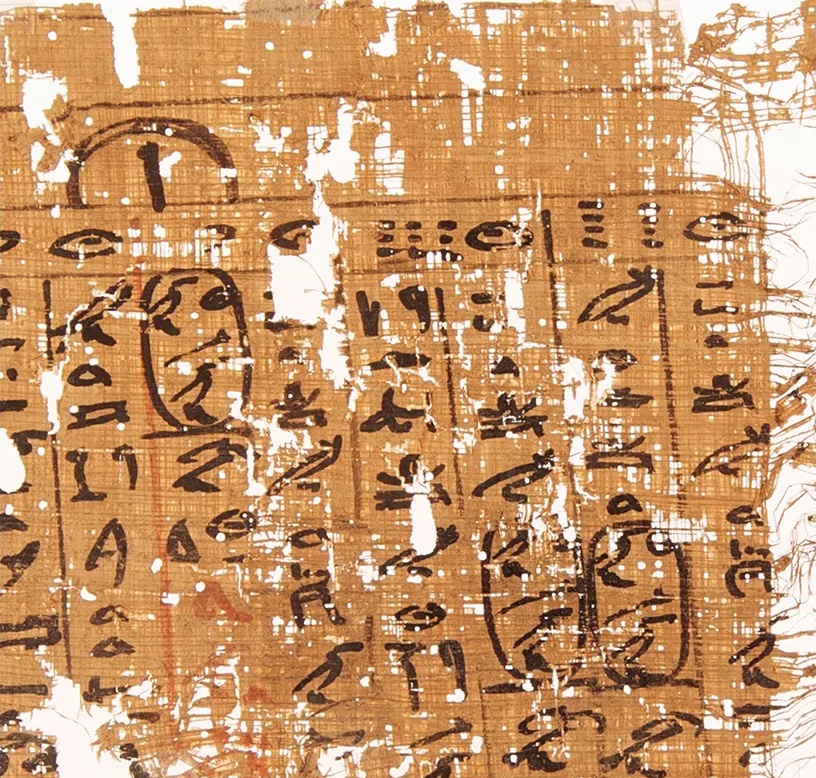
My thoughts today settled on Merer, a mid-ranking Egyptian official from the third millennium BCE.
Inspector Merer kept a papyrus diary during the reign of Khufu (called Cheops by the Greeks), the pharaoh who commissioned the first great pyramid.

Why should I think of this ancient on a rainy afternoon, two days after Christmas? The answer involves a breakfast of bananas, milk, and avocado, the wrapping of gifts in discounted paper, the sound of metal scraping against asphalt beneath my car, a podcast featuring Egyptologist Kara Cooney, the aroma of black bean soup filling the house, and an unusual job offer writing for an audio serial that might just be a Ponzi scheme with an 80 cent buy-in.
In other words, I settled on Merer’s diary as a focal point to a day filled with random stimuli ranging from the ordinary to the worrisome to the sublime.
Merer’s diary, written over 4,500 years ago, documents the quarrying of limestone from beside the Red Sea at Wadi al Jarf. These two- and three- ton blocks were destined for Giza to cap Khufu’s giant monument to himself, one of the seven wonders of the ancient world. The writing provides a fascinating journey back in time that can be viewed at Cairo’s Egyptian Museum—if you can read hieroglyphics and hieratic.
But the fact of what is written there is less important to me than the fact that it was written at all.
It may not be the first writing ever done—we have developments by the Sumerians and the Chinese to thank for that. But on a cold, wet day like today, filled with random and inexplicable phenomena, I need assurance that marking time with the written word might mean something to somebody, some day. Even if its for an audio serial of dubious merit.
##
 Ben East Books
Leave a comment