Distinguished Careers in U.S. Diplomacy
I’m sharing sketches of the American diplomats featured in Profiles in Service: Peace Corps Roots in American Diplomacy (ADST / Arlington Hall Press, 2026) every Tuesday; later in the week I’ll share a related moment linking Peace Corps service to diplomatic efforts, some simple, some strange, some extraordinary.
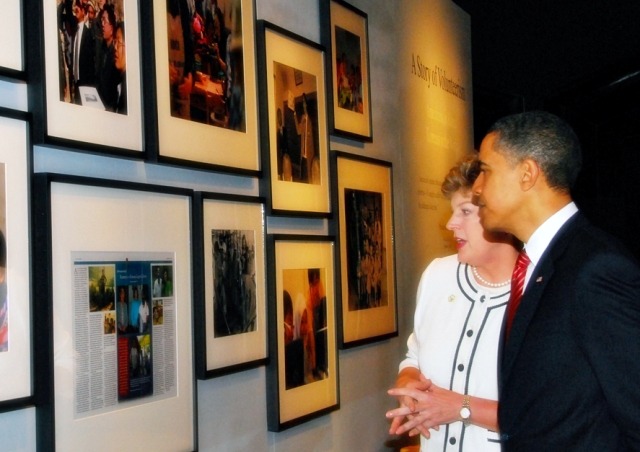
Kathleen Stephens worked in Korea during three very different eras: as a Peace Corps Volunteer during the economic development taking place in the Seventies; in Foreign Service reporting roles during the political revolution throughout the Eighties; and finally as U.S. Ambassador (2008-11) after Korea had achieved prominence on the global stage.
She was the first woman U.S. Ambassador to Korea, and the only one up to that point who spoke Korean.
At Home in Korea
An early stop during her tenure as ambassador would be to Yesan, a place she’d come to think of as her Korean hometown: she taught at Yesan Boys Middle School as a volunteer from 1975-77.
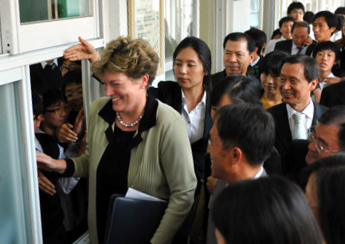
Her work would include a large policy agenda, including the future of a Korea-U.S. free trade agreement; resuscitating the Six Party Talks with North Korea; Korea’s recent membership in the G20; Korea’s admittance to the U.S. visa waiver program; the five-decade search for a new embassy chancery site; and myriad security issues related to the U.S. military presence on the peninsula.
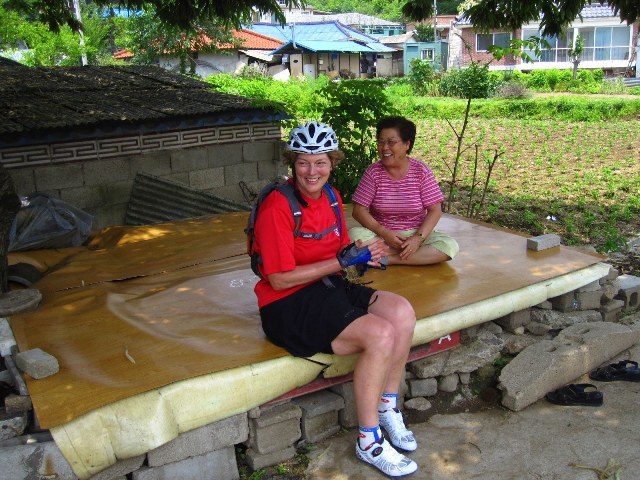
Also, there was the very human work of making connections with ordinary Koreans throughout the countryside, many times on long cycling tours.
Towards the end of her tenure, she would visit the Cheong Wa Dae gardens surrounding Korea’s executive mansion and presidential residence. President Lee Myung-bak, who’d established World Friends Korea on the model of the Peace Corps, was celebrating the third anniversary of Korea’s corollary.
Full Circle
The moment hearkened back to JFK’s signing of Executive Order 10924 in 1961, authorizing the Peace Corps to exist within the Department of State. He declared his intent that the agency should “help foreign countries meet their urgent needs for skilled manpower.” And he also said:
Let us hope that other nations will mobilize the spirit and energies and skill of their people in some form of Peace Corps—making our own effort only one step in a major international effort to increase the welfare of all men and improve understanding among nations. -JFK, 1961
The Republic of Korea fulfilled that dream some four decades later, the first and only Peace Corps host country to become a sending country for international volunteers. They dispatch hundreds of volunteers each year, the World Friends Korea, through the Korea International Cooperation Agency.
For Stephens in 2011, at the Cheong Wa Dae gardens, sunlight bathed the shrubs and a breeze flicked at the flowers, Good Mountain (Bugaksan) peaking majestic behind the steep blue slope of the rooftop. President Lee had invited senior government officials, foreign dignitaries, WFK Volunteers, Korea RPCVs, and others from the international community to celebrate those Koreans now headed out to serve.
The feeling is one of having served in some way as an inspiration and model for young Koreans who now go abroad themselves to share their energy and skills and to bring back to Korea their own experiences of life in other countries. That’s what brought us into the Peace Corps and that’s what’s sending Koreans out now.
— Kathleen Stephens (PCV South Korea 1975–77; U.S. Ambassador to South Korea 2008–11)
Stephens felt a buzz in the air and an energy that carried her back half a century. Her invitation had included a request that she make remarks, something she was all too glad to do. She told the story of the Peace Corps in Korea and its influence on generations, including future Korean volunteers working in the wider world.
She spoke of Lee Soo-jin, who was among the guests and who served with WFK in Indonesia. When President Obama visited Korea the previous Fall, Ms. Lee greeted him in Bahasa, Indonesia’s language and one with which President Obama proved familiar, having lived there for four years as a child.
Read more from about U.S. diplomatic history with the oral history collection maintained by the Association for Diplomatic Studies and Training.
The ADST also offers an oral history compilation on Korea. Kathleen Stephens’ oral history is forthcoming and her comprehensive blog of her ambassadorship remains online at https://cafe.daum.net/usembassy/I2bb.
To follow Stephens’ and others’ stories from Profiles in Service, consider subscribing below. And please share your thoughts in the comments section. Thank you.
##


 Ben East Books
Leave a comment