
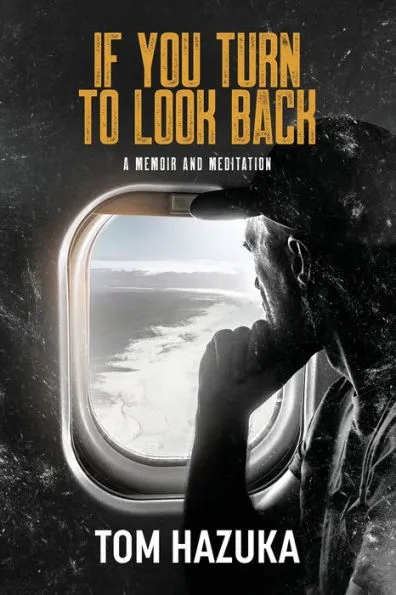
Toward the end of his memoir, If You Turn to Look Back, Tom Hazuka finds himself in front of the place where it all began a quarter century earlier. He’s standing outside his old Peace Corps training center in a residential neighborhood of Santiago, Chile, his fingers wrapped around the gate.
His 2003 tour has brought him to this point after two weeks introducing his wife, Christine, to local friends Hugo and Any in northern-most Arica; a road trip to one of Pinochet’s notorious detention and torture centers in Pisagua; and a deep excavation of mind and memory from his thirty months as a Volunteer coaching youth baseball in a soccer-mad, dictator-stricken nation.

It’s here in Santiago, in front of the centro de capacitación, that past meets present in emotionally charged release.
He’s locked out, looking in at the time-worn, two-story former residence. For ten weeks in 1978 he studied Spanish here, learned Chilean culture, was indoctrinated into service with sixteen others. He was twenty-one, the rest not much older, all but two of them single.
The past is right there, observable. The gate shuts it out, untouchable. The weight and wonder nearly break him, tears welling up.
From a pocket he pulls his customary note-taking tool, a folded piece of paper, and breaks the spell. In the most Peace Corps way possible, he jots a note revealing the one thing to stop the tears from flooding down: the torrent of need pressing his bladder. He shuffles off to find a bathroom, then steels himself for more emotional encounters.
We are with him now, the vibrant present looking back at a blurry past, teased as much from old photos, journals, and letters, as it is from this vital trip inspired by the shared grief of an old friend reacting the day after 9/11 by email: “We are in pain.” He has three more stops to make.
First, the home of an old flame, wooden shutters of her bedroom drawn tight against the afternoon. Next, the home where he lived when he first came to Chile, the owner moved on two decades ago, forwarding address unknown. Finally, the National Stadium, where he was introduced to Chilean baseball.
Days earlier, over dinner and drinks with another ariqueño friend, he asks: “Why did it all die?” He means baseball, and the dream of helping Chileans understand the United States not by its policies and politics, but by its culture and humanity.
He hears pain and exasperation in Carlos’s explanation: the erosion of economic support, the government favoring private education over public. With most coaches earning dismal salaries as teachers, many took second jobs and had to give up coaching. A familiar story everywhere, perhaps more so where the Peace Corps sets up shop.
But in his visit to the National Stadium, he finds hope of a different reality. Maybe not the lasting influence some Peace Corps programs help establish in their countries of service, but a sign of hope just the same.
“The generic concrete oval is smaller than I remembered, and shabbier, with plenty of rust and peeling paint. After a circuitous route around trees, walls, and fences I find the fields (plural! four of them!).”
He squeezes through a gap in the fence to find more.
“I wander around the fields—some for Little Leaguers, some regulation-size—thick grass underfoot like an overgrown golf green…. What a contrast to my first trip to the National Stadium in 1978, when the single field was mostly just dirt and scraggly weeds. Now there’s not only decent grass, but dugouts, outfield fences, sturdy backstops—even an electric scoreboard on the main field.” Missing light bulbs and disconnected wiring on the scoreboard notwithstanding, the fields show care, maybe a cause for optimism, lasting impact, past reaching forward to present.
He’s taken us to a quiet place on a hot afternoon, empty and sepulchral. For many Chileans, the National Stadium is just that, a sinister presence and symbol of repressive dictatorship. So it is for Hazuka.
But it’s also a scene of hope. It’s the place of victory for his Little Leaguers from Arica who won the national championship the year after he left. Perhaps seeking connection to how the victory felt for them, he takes to the mound and looks in for a sign. No sign is coming. He flips sides, takes his place in the batter’s box. No pitch comes. It’s a scorching day. It’s time to go.
Whether or not this memoir reclaims the past for Hazuka, it certainly allows him to confront it. Better yet, the process allows him to pull back the curtain on that formative experience for his wife and for the reader. He writes of more joy than regret, of more revelation than mystery. And the trip that inspired it is itself a testament to the value of his Peace Corps service and other experiences forging friendships abroad. Is it not a result to receive the sympathy of an old friend, from far away, in a moment of great national crisis?
Carlos tells him the Arica championship never would have happened without Tom. Hazuka feels certain it wouldn’t have happened without Carlos. Can’t both men be right?
“I remember arriving in Arica, no baseball programs in place, nothing organized—yet within three years the kids were national champions. I’m proud of that, even if most tangible evidence of my work is gone. Yellowed newspaper clippings are about all that’s left, with some photos and a few cheap trophies on dusty shelves.”
As much of the memoir reveals, it’s those yellowed clippings, “the past on paper,” as Hazuka calls it, that matter. Hazuka’s meditation on youth and friendship and the passage of time would have been impossible without his own trove of experience set down in journals, letters, and photos.
Having talked to many of his friends about those times to correctly tease out every detail, he found one thing constant: “We’re all astonished by how much we’ve forgotten. Such is the lot of human wanderers in the hazy maze of time.”

 Ben East Books
Leave a comment