
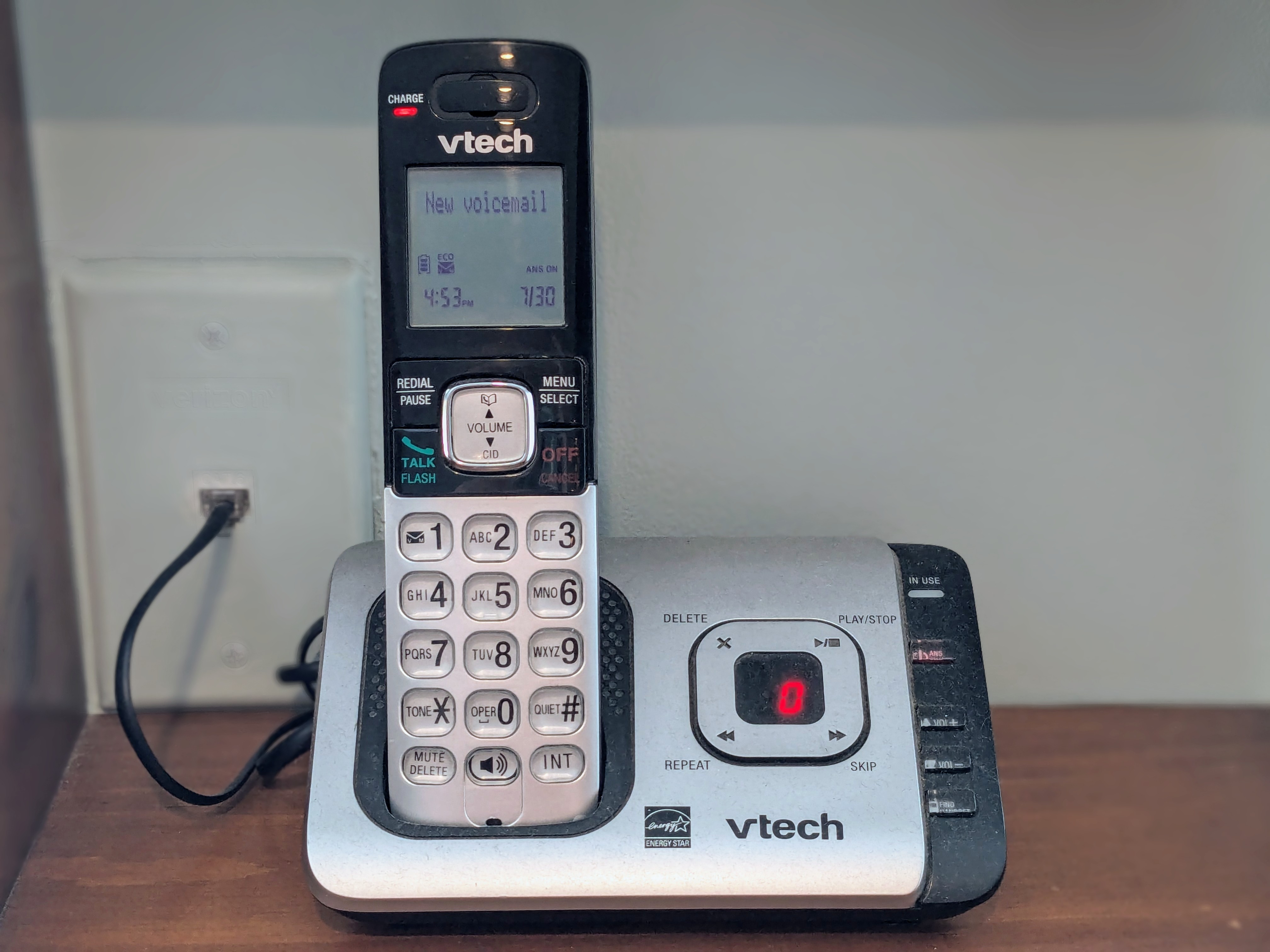
The calls start a little before three pm. Every five minutes the landline rings and caller ID shows a U.S. Government caller. You pick up, say hello, and are greeted by the springing and boinging of a fax machine. Re-dial produces the same sounds. Five minutes later, another call from the same number with the same result.
This occurs during the final session of a series of sessions designed to contemplate your own demise. You’ve spent the day in a financial seminar with your spouse, both of you poking your eyes out with pencils when not taking notes on facts that might have been helpful ten years ago or will become helpful about ten years from now.
It’s your twentieth anniversary. Happy anniversary, hon’.
–
You have a long history of resentment and loathing toward the telephone. Phone calls with the home warranty company, Chince, merely made you hate them all the more. In the age of artificially “intelligent” menus and robot prompts, by the time you’re dealing with a human being at Chince you’ve described your problem in multiples of ten and still must tell the agent why you’re calling.
If the agent is Filipino, you can count on their gentle patience to mitigate the maddening truth about any call with a large corporation: the agent can listen to your troubles, but likely can’t fix them to your satisfaction. If you wind up yelling at a Filipino, you’ve probably been poking your eyes in a seminar for too long, and you are the problem.
Your present dilemma is this. A government website sends a verification code to your phone. When you type the code into the verifier, the website refuses to affirm that the phone number it sent the code to is associated with your name. Somehow the ten digits of your phone number aren’t associated with the twelve letters of your first and last name.
As a result, when you place calls to people who aren’t contacts, caller ID lists you as Tristate Slate and Tile. Tristate sounds innocuous enough, since Maine is the lone state in the continental USA that shares a border with only one state. Still, you’d prefer that caller ID show you for who you really are rather than label you a roofing business.
–
During a break in the finance seminar you contact your cell phone provider. Within a minute, the provider calls you up. It’s a U.S. number, a Filipina agent, and she’s nice, but proves unable to do more than understand how frustrating your predicament must be.
“I’m not frustrated,” you say. “I’m confused. When you called me, caller ID listed your company by name. You’re not saved as a contact, so the number must be associated somewhere with your company name. I’d like the same thing for my name and my number.”
“I understand how frustrating this must be, but we cannot make this change.”
“I don’t want people to think I’m a roofing company. I’m a private citizen, with a first name and a last name.”
“I understand how frustrating this must be. I understand why you would want it to work that way, but we cannot make this change.”
“I bought the phone from you. You assigned the number to me. How do you not have the ability to associate my number with my identity?”
“I understand how frustrating this must be. We do associate your number with your email address.”
“My email address is not my identity. Please disassociate the number from Tri State Slate and Tile. Which, by the way, is a terrible name, don’t you think?”
“I really can’t say, sir.”
“I mean, they shouldn’t put the rhyming words next to each other, should they? It would sound better if they spread them out, right? Tri State Tile and Slate.”
“I really can’t say, sir.”
“Well, can you at least update your records to show that this number is associated with the private citizen named Benjamin East?”
“I really can’t do that, sir. But I’ll tell you what I can do. I can send an email indicating that the last four digits of this number are associated with the email address belonging to Benjamin East.”
“Is that all you can do?”
“I can do that much, sir.”
“That and a slice of tomato don’t exactly make a hamburger, do they?”
“I really can’t say, sir.” I did get the email, and seventeen minutes on the phone weren’t entirely for nothing, but it certainly wasn’t a hamburger.
–
When the seminar ends, you bandage up your eyes and pick up the phone to call your IT provider. “I’m outta here,” says your spouse, a frequent witness to your one-sided outrage during calls with service providers. Just ask the good people at Chince.
The agent doesn’t keep you waiting long. He patiently guides you through several steps to verify your credentials, then shows you how to add numbers to your blocked caller list. You can store up to 300 numbers, so people better start being nice.
Here’s the best part. You’re so tickled by the success that you say, “This is fantastic. Thank you so much. When I first dialed you, everyone in the house fled the room. My spouse even said, “I’m outta here,” and took off. And it’s our twentieth anniversary! I have a solid reputation for over-reacting during these kinds of calls.”
The agent falls into an easy chuckle, a good-natured, approachable laughter at your honesty. You suppose he’s been on the far side of a few angry calls in his day, and appreciates a customer coming clean about being an asshole from time to time.
What happens next amazes you. He asks if you want a discount on your IT service and of course you do. You’re in the middle of a finance seminar, after all. After some back and forth, the agent finds a way to reduce your monthly bill by more than twenty percent.
“This is great,” you say.
“I bet people are coming back into the room now,” the agent says.
“They are, they are indeed,” you say. “Everyone’s here, eating out of my hand. Even the dog.”
After you hang up, you peel the bandages off your eyes and get ready to celebrate twenty years of marriage with your spouse and sons.
“Dinner’s on me,” you say.
##
 Ben East Books
Leave a comment